Komax Systems manufactures custom process equipment for applications requiring consistent inline mixing, controlled steam heating, desuperheating and heat transfer. Its product portfolio includes static mixers, direct injection steam heaters, desuperheaters, sludge heat exchangers and tank heads engineered around the operating conditions of each application.
Komax Static Mixers and Process Heating Equipment
Engineered Inline Mixing, Steam Heating and Heat-Transfer Solutions
What Does Your Process Need to Accomplish?
Blend Multiple Process Streams
Combine liquids, gases or process additives directly within the pipeline without installing a motor-driven mixer or separate mixing vessel.
Disperse an Injected Chemical
Improve the distribution of treatment chemicals, polymers, coagulants, acids or other additives before the stream reaches the next process stage.
Heat a Flowing Liquid With Steam
Introduce steam directly into a compatible process stream where rapid heating, close temperature control and a compact installation are required.
Heat Sludge or Solids-Bearing Media
Transfer heat into sludge, manure, FOG and other difficult fluids while addressing fouling, scaling and restricted flow.
Control Superheated Steam Temperature
Condition superheated steam or gas to a specified downstream temperature using controlled cooling-water injection and multi-stage mixing.
Complete a Tank or Pressure Vessel
Specify a conical, dished or flanged head around the vessel diameter, operating pressure, material and fabrication requirements.
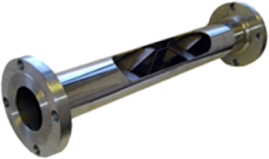
Inline Static Mixers
Komax inline static mixers use fixed internal mixing elements and the energy of the flowing process stream to blend liquids, gases, chemicals, slurries and other media without motors or rotating components.
Configurations can be designed around line size, flow conditions, available pressure drop, construction material, injection requirements and end connections. Available designs include channel, sanitary, FRP, custody-transfer, metal-alloy, non-clogging, lined, PVC and wafer static mixers.
Common applications include:
- Chemical injection and dispersion
- Fluid blending and homogenization
- pH adjustment
- Coagulant and polymer mixing
- Custody-transfer conditioning
- Sludge and slurry mixing
- Gas-to-liquid mixing
- Sanitary process blending
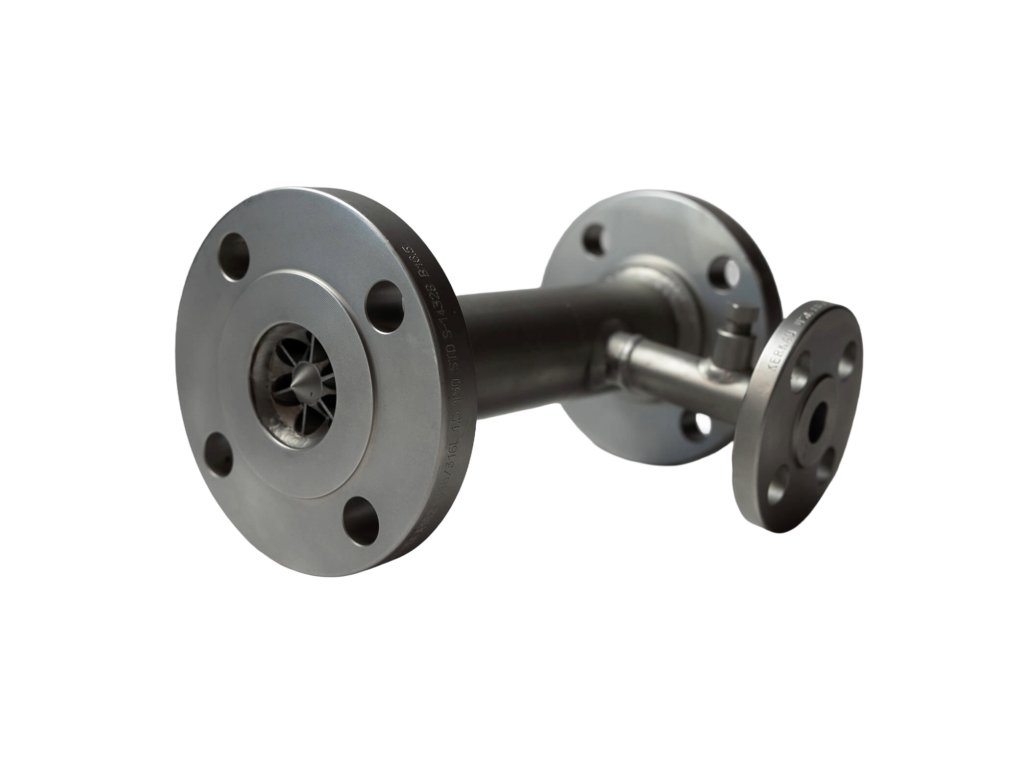
Direct Injection Steam Heaters
Komax steam heaters introduce steam directly into a compatible process stream and use internal mixing elements to promote rapid steam dispersion and uniform heating.
Available configurations include direct injection steam heaters, sanitary inline steam heaters, steam sparger tank heaters and tailings solvent recovery heaters. Selection is based on process flow, inlet and outlet temperatures, operating pressure, line size, materials and available steam conditions.
Common applications include:
- Inline water heating
- Process temperature control
- Sanitary liquid heating
- Tank and vessel heating
- Slurry and tailings heating
- Rapid heating within limited installation space
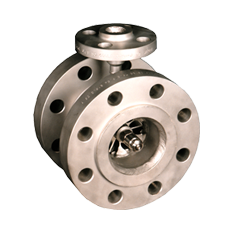
Desuperheaters
Komax desuperheaters reduce the temperature of superheated steam or gas by introducing a controlled cooling-water stream and mixing it into the main flow.
The appropriate configuration depends on steam flow, inlet and outlet pressure, inlet and target temperature, cooling-water temperature and pressure, line size, material and required turndown. Komax offers steam and LNG desuperheater configurations using a multi-stage mixing approach.
Common applications include:
- Steam temperature control
- Turbine bypass systems
- Process steam conditioning
- Boiler and power-generation systems
- Petrochemical processing
- LNG and industrial gas service
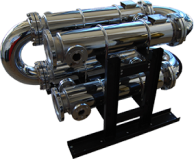
Sludge Heat Exchangers
Komax sludge heat exchangers are designed for heating municipal sludge, fats, oils, grease and manure used in aerobic or anaerobic digestion processes.
Internal mixing elements promote turbulence near the heat-transfer surface and help address the buildup, scaling and plugging challenges associated with solids-bearing media. Systems can also recover heat from outgoing digested sludge to preheat incoming material.
Common applications include:
- Anaerobic digestion
- Municipal sludge heating
- Manure and agricultural-waste treatment
- Fats, oils and grease processing
- Digester recirculation loops
- Sludge-to-sludge heat recovery
Mixing and Thermal Solutions for Demanding Processes
Water & Wastewater
Support chemical dosing, pH adjustment, coagulation, polymer activation, sludge conditioning, digestion and heat recovery across municipal and industrial treatment processes.
Chemical Processing
Mix reactants, additives, acids, caustics and other process streams while accounting for chemical compatibility, pressure drop, temperature and corrosion-resistant construction.
Oil & Gas
Support pipeline blending, custody-transfer conditioning, produced-water treatment, refinery processes, steam conditioning and other upstream, midstream and downstream applications.
Power Generation
Control steam temperature, blend treatment chemicals and support boiler, condensate, cooling-water and auxiliary process systems across varying plant loads.
Food & Beverage
Provide sanitary inline mixing and direct steam heating for viscous or low-viscosity products where cleanability, consistent blending and controlled process temperatures are required.
Pulp & Paper
Mix chemicals, additives, black liquor and process streams while supporting steam heating and temperature control in services involving corrosive or solids-bearing fluids.
The pressure-drop allowance should be determined from the complete hydraulic system rather than assigned independently to the mixer. Engineers should evaluate the pump or upstream pressure source, minimum and maximum flow, control-valve requirements, downstream equipment and expected system fouling.
A lower pressure-drop limit may reduce the mixing energy available within the device, while an unnecessarily aggressive design can increase pumping costs or affect upstream and downstream control. Komax requests minimum and maximum flow, fluid properties and pressure-loss limits when evaluating channel mixer applications.
Reynolds number, viscosity, density, yield behaviour, phase ratio and flow range affect how material divides, rotates and recombines through the mixer elements. A design suitable for turbulent, water-like flow may not provide the same performance with a laminar, shear-sensitive or non-Newtonian fluid.
The number, length and arrangement of mixing elements should therefore be selected around the actual process fluids and the required degree of mixing. Komax determines static mixer length and element quantity according to line size, application and flow conditions.
Engineers should provide minimum, normal and maximum flow, line size, density, viscosity, phase information, injected-stream flow, operating pressure, temperature and available pressure loss.
The required process result must also be defined. This may include a target level of homogeneity, chemical dispersion, sampling accuracy, reaction completion or temperature uniformity. Fluid data alone cannot establish whether the proposed mixer will meet the actual process objective.
The injection point should allow the additive to enter the main stream in a manner that promotes rapid distribution without creating localized corrosion, precipitation, flashing or uncontrolled reaction.
The review should consider injection orientation, velocity ratio, phase compatibility, required reaction time and the distance available before an analyzer, sample point, heat exchanger or downstream process. Injection ports and internal elements should be evaluated as one mixing system rather than as unrelated components.
Direct steam injection may be appropriate when the product is compatible with direct steam contact, a small increase in mass is acceptable and rapid heating within a compact footprint is desired.
An indirect heat exchanger is generally more appropriate when the process cannot tolerate direct steam contact, condensate addition or potential contamination. The decision should also consider steam quality, pressure control, product sensitivity, turndown, maintenance and the required temperature approach. Komax sizes direct injection heaters using flow, inlet and outlet temperature, pressure, line size and material data.
Performance depends on steam flow, inlet pressure and temperature, target outlet condition, cooling-water temperature, available water pressure, droplet size, mixing intensity and downstream evaporation distance.
The target temperature must provide an appropriate margin above saturation for the application. Operation too close to saturation without complete water evaporation can introduce wet steam, thermal cycling and downstream piping concerns. Komax states that its desuperheater can operate at turndown ratios of up to 20:1 with appropriate pressure control.
Material selection should consider chemical compatibility, concentration, temperature, velocity, solids, erosion, corrosion allowance and expected service life. Engineers should evaluate the body, mixing elements, injection components, welds, linings and connections rather than specifying only the external pipe material.
Sanitary applications also require consideration of internal finish, drainability, removable components and cleaning procedures. Komax offers static mixers in plastics, lined constructions, steel materials and specialty alloys, along with electropolished sanitary configurations.
A retrofit review should verify line size, flange standard, pressure rating, available installation length, piping supports, equipment weight, nozzle loads and maintenance clearances.
Engineers should also examine upstream flow disturbances, injection location, downstream straight-run requirements, instrumentation and the additional system pressure loss. Komax static mixers can be customized with different lengths, materials, injection ports, element configurations and end connections to suit existing systems.
Solids size, concentration, fibre content, settling behaviour, viscosity and minimum velocity should be evaluated before selecting a mixer or heat exchanger.
Narrow flow passages or low-velocity zones can increase the risk of plugging and buildup. For sludge and other solids-bearing media, the design should also include access for inspection or cleaning and account for performance as the equipment accumulates normal process deposits. Komax offers non-clogging static sludge mixers and sludge heat exchangers with internal mixing elements intended for difficult media.
Request a Quote!
Need Help Defining the Right Komax Solution?
Tell us what your process needs to mix, heat or control. Share your flow range, fluid properties, temperatures, pressures and piping requirements, and our team will help evaluate the appropriate Komax equipment for your system.